
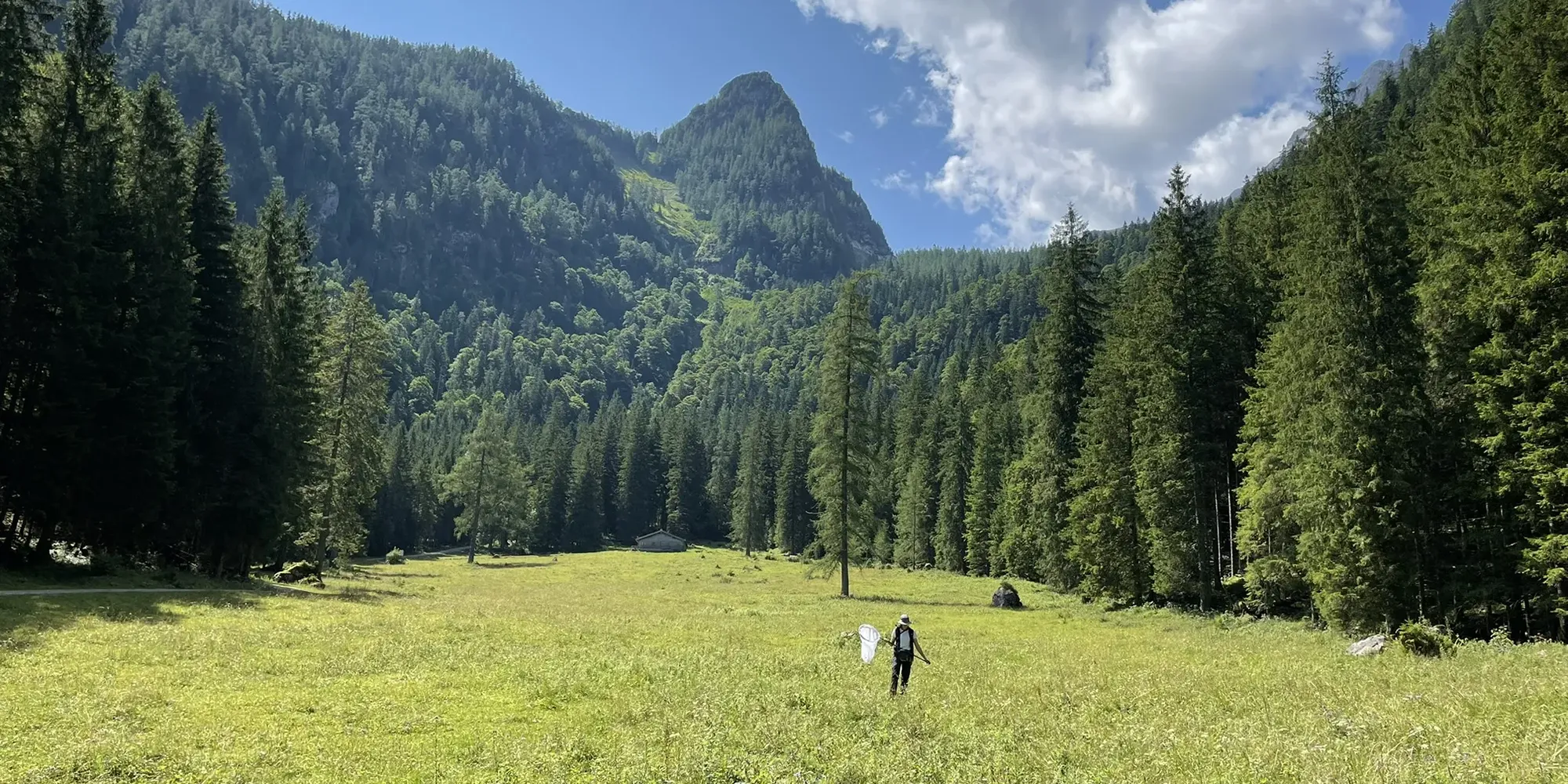

Overview: When Insects keep the World in Balance
Insects are the silent engines of our ecosystems. They pollinate crops and wild plants, decompose organic matter, regulate pests, and form the foundation of the food web for numerous animal species. Without them, stable ecosystems—and by extension, a productive agricultural sector—would be inconceivable.
At the same time, evidence of profound changes in insect populations has been mounting for years. Long-term monitoring programs and scientific studies document shifts in biomass, abundance, and species composition. In parallel, the number of observations from citizen science projects is growing steadily. While this wealth of data offers new opportunities, it also presents research and practice with new challenges: How can short-term, weather-related fluctuations be distinguished from long-term trends? And how can robust, area-wide predictions be derived from scattered, point-based observations?
This is where bAImo comes in.
Within the framework of bAImo, a modern, model-based insect monitoring system is being developed for the Free State of Bavaria. It combines artificial intelligence with ecologically sound models and integrates a wide variety of data sources—ranging from standardized monitoring programs to citizen science data. The goal is to accurately contextualize short-term fluctuations within weather and climate patterns and to derive robust conclusions about the status and development of insect populations.
The unique strength of bAImo lies in its interdisciplinary approach. AI methods, data integration, and practice-oriented ecological research work in tandem. The project is supported by high-performing Bavarian research institutions with close networks to government agencies, associations, and data providers. As part of the bayklif2 network, bAImo makes a central contribution to climate impact research by creating a scalable early-warning tool for climate-induced changes in insect populations.
Background
For years, insect biomass, abundance, and species composition in Germany and Bavaria have shown significant changes, frequently in the form of declining trends. In addition to land-use changes, climatic factors are increasingly impacting these developments: rising temperatures, altered precipitation patterns, extreme weather events, and shifts in seasonal cycles.
But what do these changes actually mean? A hot, dry summer can cause populations to collapse in the short term without necessarily indicating a long-term trend—just as favorable weather years can lead to temporary recovery phases. Conversely, subtle, climate-induced changes can remain undetected for a long time. Despite extensive monitoring programs, it is often unclear how to separate short-term weather effects from long-term developments.
Methods and Goals

bAImo addresses this challenge through an integrative approach: ecological processes, observation processes, and modern AI modeling are systematically merged.
A central element is a deepened understanding of ecological mechanisms. Only by knowing which environmental factors truly influence populations can models be structured realistically and relevant variables identified. Short-term weather effects are specifically investigated, quantified, and integrated into the model structure.
Simultaneously, bAImo consistently distinguishes between the ecological state and the observation process. A large portion of available insect records comes from opportunistic surveys. Visibility, survey effort, weather conditions, and accessibility significantly influence whether an insect is reported or not. If these effects are not taken into account, misinterpretations may arise. Therefore, observation processes are explicitly modeled—a crucial prerequisite for making meaningful use of heterogeneous datasets.
Building on this, innovative model-based approaches are employed. Community-based models utilize information shared between species, increasing predictive power, particularly for rare species. Additionally, modern AI methods allow for a realistic representation of complex spatial and temporal dependencies that go beyond classical statistical methods.
The bAImo research strategy therefore combines three components:
- Ecological process understanding
- Targeted field data collection under varying weather and seasonal conditions
- AI-supported, hierarchical modeling
Through this integrative approach, the information content of existing monitoring data is exhausted as fully as possible. Different data sources are merged, biases are accounted for, and high-resolution spatial and temporal predictions for all of Bavaria are made possible.
Immediate Impact for the Free State of Bavaria
bAImo provides an innovative, model-based insect monitoring system that combines modern AI methods with ecological expertise. The results are directly applicable to nature conservation issues. Authorities and decision-makers receive a reliable foundation to strategically supplement monitoring programs with citizen science data and to make them more efficient.
This creates improved decision-making bases for nature conservation, biodiversity strategies, and climate adaptation. Species of particular ecological and legal relevance, such as those in the Natura 2000 network, can be protected more effectively, and public funds can be used more efficiently through prioritized monitoring. At the same time, bAImo strengthens Bavaria as a hub for innovative biodiversity research.
In the long term, the project contributes to securing biological diversity and essential ecosystem services – and thus the ecological future of the Free State.
Potential Synergies within bayklif2
Synergies arise primarily through data exchange, methodological interfaces, and joint workshops aimed at the further development of integrative climate and biodiversity analyses. Existing collaborations with state authorities, nature conservation associations, and research institutions will be specifically expanded.
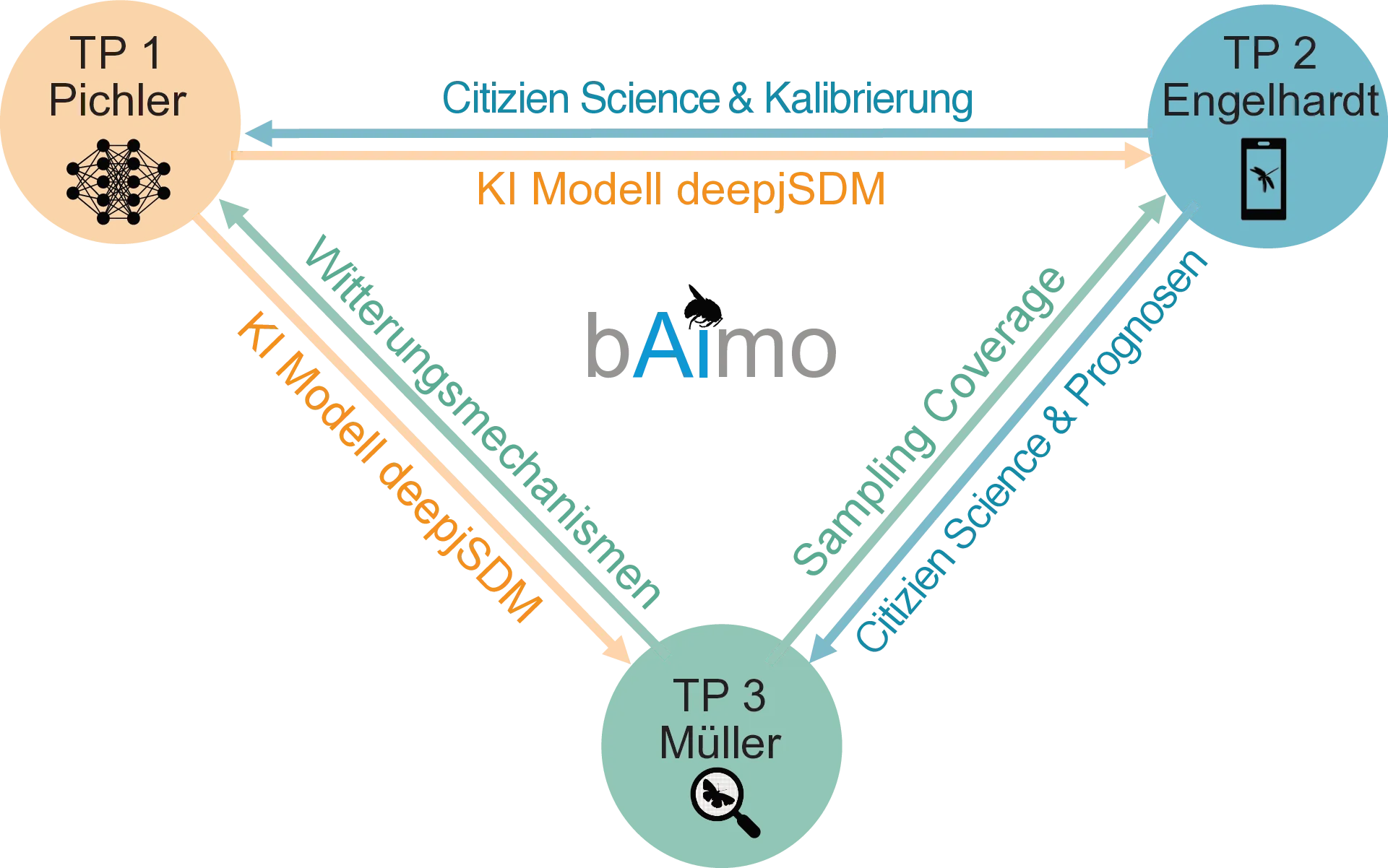
The developed model and monitoring concept is modular, scalable, and transferable to other regions and species groups. Consequently, bAImo opens up concrete perspectives for follow-up projects, such as extending the system to other taxa or integrating additional environmental and remote sensing data. The model framework can be integrated into existing monitoring programs and permanently established as a decision-support system.
bAImo tells a story for Bavaria’s insects and for the future of our ecosystems—a story of innovation, collaboration, and responsibility.


The team of bAImo
Principal Investigator

Dr. Maximilian Pichler
University of Regensburg
Theoretical Ecology

Principal Investigator

Dr. Eva Katharina Engelhardt
University of Würzburg
Global Change Ecology
Principal Investigator

Prof. Dr. Jörg Müller
University of Würzburg
Conservation Biology and Forest Ecology
Scientific Assistance

Mariana Sáenz
University of Regensburg
Theoretical Ecology
Scientific Assistance

Pia Marina Falter
University of Würzburg
Global Change Ecology